

The Palm-Leaf Fan and the Lessons of Life, Hoa Tien village, 2026
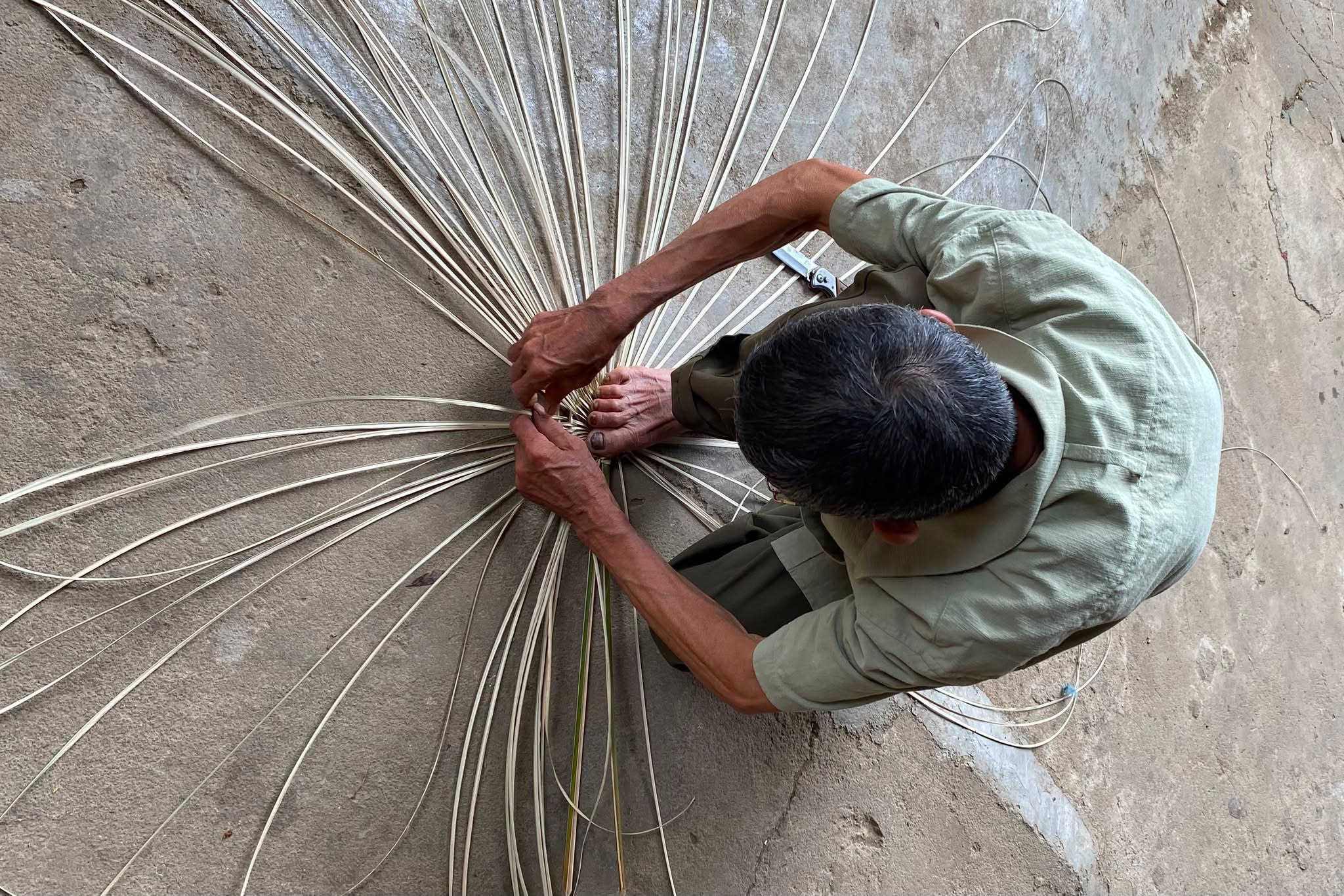
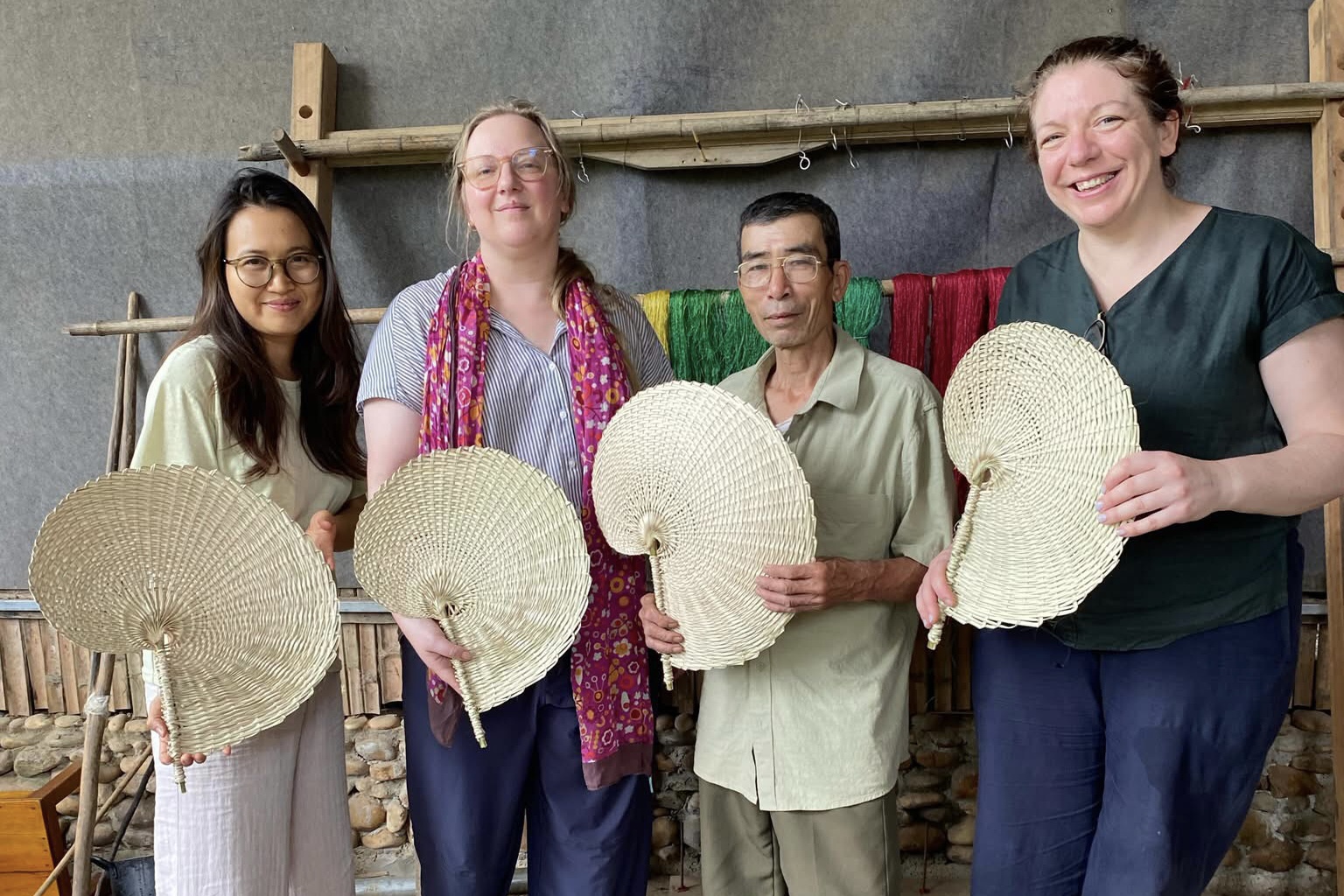
It has been almost a month since my field trip, yet every time I fan myself with this handmade palm-leaf fan, I am reminded of the children’s song “Đi học” (“Going to School”), with its image of palm leaves opening like little umbrellas to shade a child on the way to school. This time, unlike my earlier short trips which were somewhat rushed, I stayed in Hoa Tiến village for almost a week. Besides the slow experiences of natural dyeing, embroidery and weaving with cô Bích, she also introduced us to chú Lường, who taught us how to weave palm-leaf fans. Anais and Anne Laure, my two participants, and I had never done this before, so we were very excited.
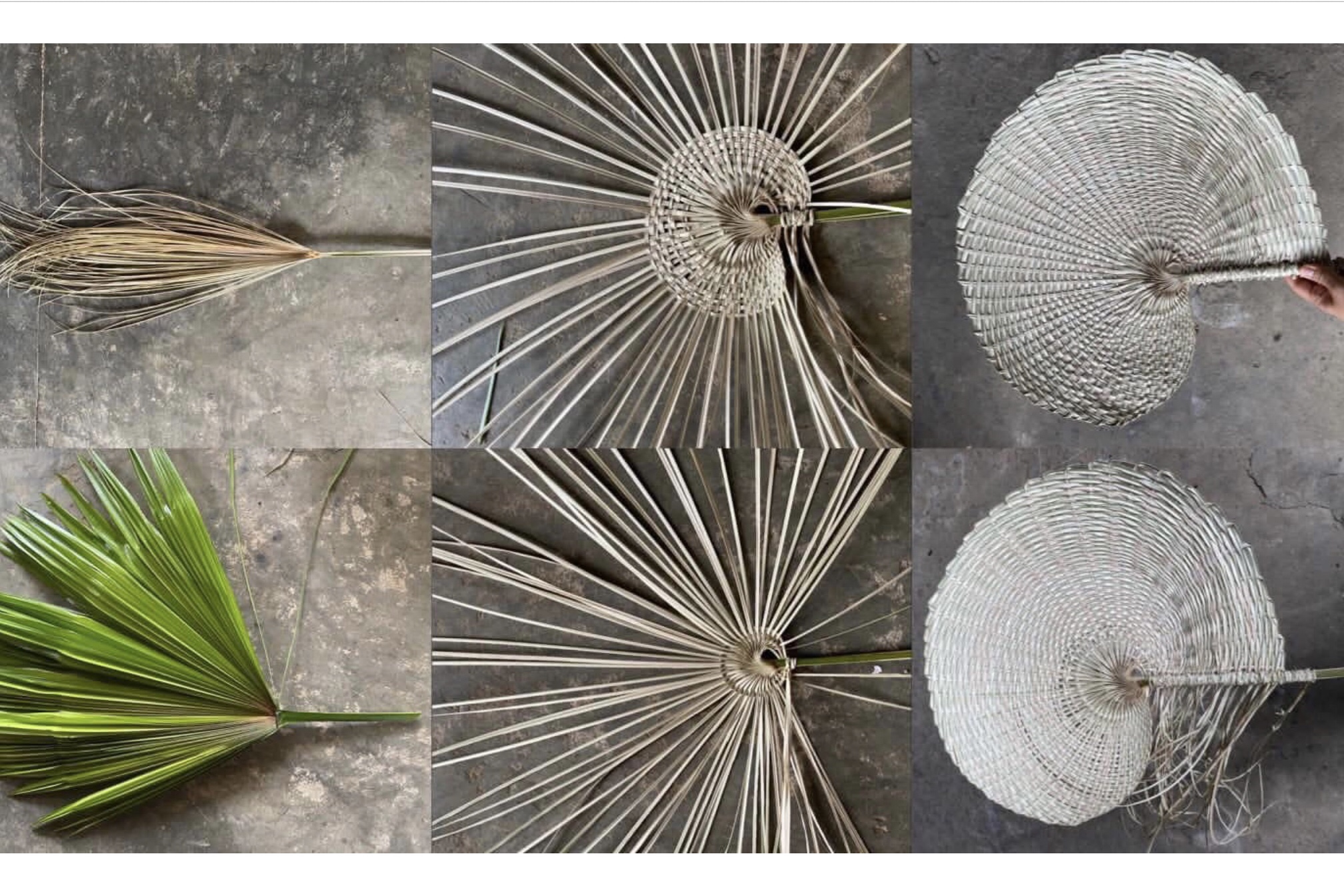
The preparation took several days. Chú Lường had to find palm leaves that were neither too young nor too old, that is, leaves that had not yet fully opened and were still slightly closed. Such leaves remain flexible, their ribs are not too fibrous, and their colour is a medium green or just beginning to turn a pale yellow-green. He then split the leaves, keeping only the ribs and a little of the blade, and dried them in gentle sunlight until they turned ivory yellow, while keeping them soft enough to bend and weave. Chú Lường had brought only dried leaves, so we could not picture what fresh ones looked like. Suddenly cô Bích rode off. I did not know where she was going; it turned out she had gone to find fresh palm leaves to show us. She does everything quickly and neatly, and she always finds a way. When I held a leaf over my head like a sunshade, I thought of song “Đi học”, and together with cô Hoa, who was weaving cloth nearby, I began to hum quietly. Working and singing together, the atmosphere was cheerful.
Chú Lường is careful and meticulous, attentive to every detail. At first he bent the strips to form the frame and wove the first few strands to hold it in place, so that we could continue with the easier part, because he was afraid that we, being unaccustomed to it, would damage the strips. However, we wished to learn by doing everything from the beginning, so he made a sample and everyone followed. It looks as if one simply weaves up and down, but when you do it yourself, you realise that strength is needed to hold the base firmly, and your hands must bend the strips neither too tightly nor too loosely. After sitting for a while, everyone had a sore back and sore knees. Our foreign participants could not squat, so they kept changing position until we brought a low stool.
The direction of the strips must be consistent, meaning that the rib and the leaf part must run the same way. At first we did not notice this, so some strips had the rib on the right and others on the left. Weaving them like this is still possible, but the result will not be as beautiful. Chú Lường said: “If I don’t make something, fine, but once I make it, it has to be beautiful. Otherwise people will say: this man doesn’t look so bad, why did he make such a careless fan?” I admired this attitude very much: if he does not do something, so be it, but when he does, he does it thoroughly. He told us: “When I first started, I made it again and again. If it wasn’t beautiful, I threw it away, and I only stopped when it was. These fans don’t sell enough to repay the effort, so I only make them as gifts.” Indeed, only when small things are done with care can later things be done with care. Then chú Lường joked by singing a line from a song about being angry with someone and yet still loving them, and being unable to bear seeing the one you love take the wrong road. So, do not take the wrong road: choose one road and follow it correctly. We went back to working and singing, in a very cheerful atmosphere.
Once we were weaving in the right direction, Anais wove too tightly while I wove too loosely. Chú Lường remarked that one person pulled so hard that the whole fan became curved. Anais said to me: “Perhaps it is because my hands are strong from working with leather, where you have to pull tight. I also tend to tense up too much.” And I replied: “I am the opposite: I am used to letting go, and I am a little undisciplined. We balance each other out, and that will make it beautiful.” Chú Lường told me: “You need to tighten more, otherwise there will be many gaps. Your edge is climbing a mountain and is almost at the summit of Fansipan.” Then he helped me rework the rim so that it would hold firmly. If the top is too high, the strips are not long enough to be knotted onto the stem. As for the knots, there is no need to wrap too many times; a moderate amount is enough, because too much wrapping makes the fan less secure, and it must always follow the right direction, with no wrong road.
Just by weaving a palm-leaf fan, I took away many life lessons: do everything carefully, tighten when you need to tighten, and let go when you need to let go. When we finished, chú Lường praised us: for a first attempt it was good, because when he started himself, he could do no better. Each of us had our own flaw, our own wobble, tight or loose, so one could recognise at a glance whose fan was whose. Anne Laure called it our “personal signature”. That is precisely what gives handmade work its value.